

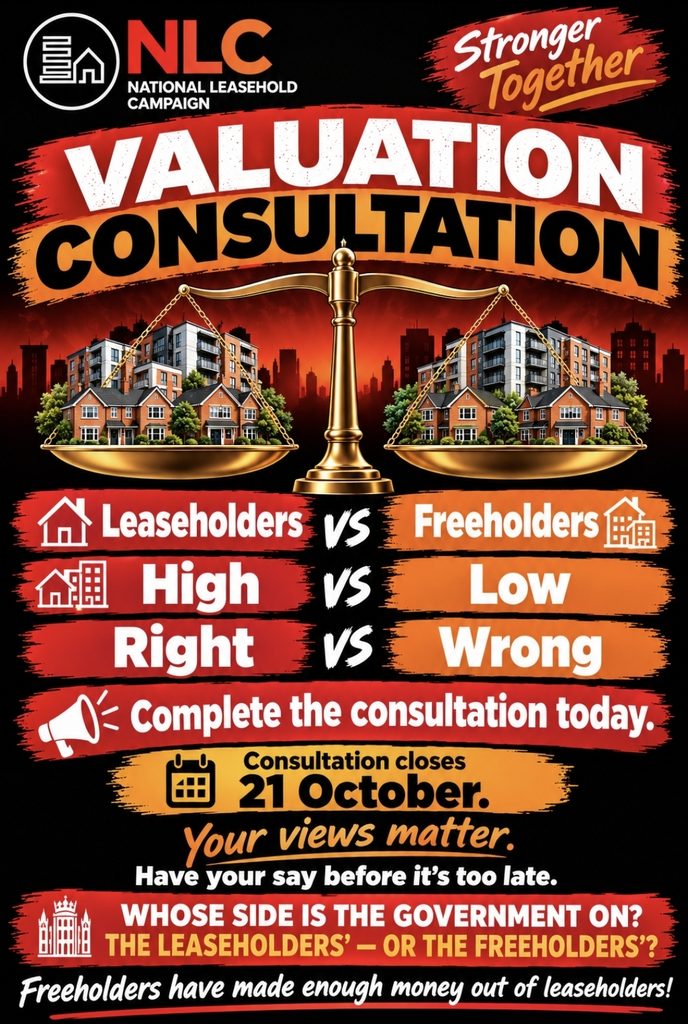
Why the Government’s valuation rates consultation matters to every leaseholder, and why campaigners need to make their voices heard before 11:59pm on 21st October 2026.
Don’t leave this debate solely to the professionals and institutional interests. Leaseholders have a direct stake in the outcome and our voices need to be heard.
Briefing for Leasehold Campaigners: Enfranchisement Valuation Rates Consultation
Consultation closes: 11:59pm on 21 October 2026
This consultation might look like one for actuaries and valuation professionals. It isn’t.
Ultimately, this is about how much money ordinary leaseholders will have to find to exercise rights over homes they have already bought.
For years, leaseholders have faced an enfranchisement system that is legally complex, expensive and unequal. The move towards prescribed rates is an opportunity to create something simpler, clearer and fairer.
But that opportunity will be lost if one complicated system is simply replaced with another, full of different classifications, exceptions, adjustments and opportunities for costly professional arguments.
The National Leasehold Campaign’s central message to Government is therefore clear:
Leaseholders must not be treated as peripheral voices in a technical discussion between valuation professionals and institutional freeholders. They are the people who ultimately have to pay the bill.
What is NLC calling for?
The National Leasehold Campaign is proposing:
- An 8% deferment rate for both houses and flats
- A 9% capitalisation rate, preferably as one single prescribed rate
- No routine property-specific adjustments that risk reintroducing valuation disputes
- No special intermediate-lease adjustment
- A simple, transparent system supported by an accessible public calculator
- Published worked examples showing what different rates would mean for real leaseholders
- Clear evidence from Government showing who gains and who loses under the final rates
- Regular monitoring, but protection for leaseholders against sudden or retrospective changes
Why does the deferment rate matter?
Put simply, the deferment rate affects the value placed today on the freeholder’s right to receive the property back at the end of the lease.
Generally, the lower the deferment rate, the higher the present value of that future interest, increasing that element of the premium paid by the leaseholder. A higher deferment rate reduces its present value.
That is why NLC supports Option 3: a flat 8% deferment rate for both houses and flats.
Why NLC challenges simply continuing Sportelli
NLC’s submission challenges the assumption that the existing Sportelli approach should simply be carried forward.
Assumptions originating in 2007 should not automatically determine what leaseholders pay today without being properly tested against the economic, legal and regulatory environment that now exists.
One area highlighted in the submission is the property risk premium. The Government Actuary’s Department (GAD) retained Sportelli’s original risk premiums of 4.5% for houses and 4.75% for flats.
NLC’s concern is whether Government has adequately demonstrated that those assumptions still properly reflect today’s circumstances.
Our position is straightforward:
Historical practice should not automatically determine what leaseholders pay in a completely different market nearly two decades later.
Why is NLC proposing a 9% capitalisation rate?
The capitalisation rate affects the value attributed to the stream of ground-rent income.
Again, a higher capitalisation rate generally produces a lower present value for that income stream, reducing that component of the enfranchisement premium.
NLC is therefore recommending a single capitalisation rate of 9%.
The NLC submission refers to analysis discussed by Leasehold Knowledge Partnership involving 706 Allsop residential auction transactions between September 2019 and February 2023, considered in the Park Hill tribunal case.
The submission notes that this analysis has subsequently been cited as indicating an average capitalisation rate of approximately 9%.
NLC is not suggesting that this evidence, on its own, automatically determines what the statutory rate should be. It must be considered in its proper context.
The wider point is important, however:
Real market evidence should be taken seriously rather than automatically defaulting to conventional valuation assumptions.
Simplicity is a major campaign issue
This consultation isn’t only a debate about whether the eventual number should be 6%, 8% or 9%.
Complexity itself costs leaseholders money.
If Government introduces multiple rates, numerous exceptions and property-specific adjustments, leaseholders could once again find themselves needing professional advice simply to establish which rate applies to their home.
That risks recreating exactly the problem that reform is supposed to solve.
NLC therefore opposes routine property-specific adjustments, including adjustments for matters such as obsolescence, and also opposes an additional adjustment for mid-term intermediate leases.
Our test for the new system should be simple:
Can an ordinary leaseholder identify the relevant rate, reproduce the calculation and understand the result without having to pay for professional advice?
If not, we haven’t simplified the system enough.
What NLC says about the impact on leaseholders
For our preferred 8% deferment rate, NLC assesses Option 3 as positive for leaseholders and moderately negative for freeholders and intermediate landlords.
The submission considers that an 8% rate would generally reduce premiums compared with the lower rates considered under Options 1 and 2, although the precise effect on an individual enfranchisement claim would depend on the property concerned and the other elements of the valuation.
For a single 9% capitalisation rate, NLC assesses the impact as significantly positive for leaseholders and moderately negative for freeholders and intermediate landlords.
It would also provide another important benefit: simplicity, with less scope for negotiation and argument over which category applies.
Our submission makes an important point:
A reduction in valuation resulting from a more appropriate discount rate is not, in itself, evidence that freeholders are being treated unfairly.
NLC’s preferred Government options
Deferment rates
NLC ranks the options:
1. Option 3: New flat rate of 8%
2. Option 2: Updated Sportelli approach
3. Option 1: Continue the existing Sportelli rates
NLC does recognise a practical issue with Option 3.
There is a risk that a new flat rate could face significant legal challenge from freeholders, potentially delaying implementation.
For that reason, the submission recognises that an updated Sportelli-based approach producing a deferment rate of around 8% could be acceptable to leaseholders, provided there are appropriate safeguards around future reviews and volatility.
Capitalisation rates
Our order of preference is:
1. Option 1: One single prescribed rate, with NLC arguing for 9%
2. Option 2: Three prescribed rates
3. Option 3: Alternative approach
NLC believes that one clear rate offers the strongest consumer benefit because leaseholders can understand what applies while reducing the scope for arguments about which category a particular property falls into.
Protecting leaseholders in the future
Getting the initial rates right is important, but the system also needs safeguards to protect leaseholders in future.
NLC is calling for:
- Annual published monitoring of the indicators used to determine whether a fuller review is necessary
- Proper evidence and independent peer review ahead of the statutory ten-year review
- A published threshold setting out when a change in rates would be considered
- Worked examples comparing existing and proposed rates
- A clear implementation date with a reasonable lead-in period
- No retrospective rate changes
- An accessible public calculator available before the new rates take effect
- Consideration of transitional protection where a future change materially increases premiums for leaseholders who have already incurred costs or made financial decisions in reasonable reliance on the previous regime
These protections matter.
Leaseholders need to be able to budget, plan and make major decisions about their homes with a reasonable degree of certainty.
The campaign takeaway
The detail may be technical, but the NLC campaign message doesn’t need to be:
8% deferment. 9% capitalisation. One clear, transparent system.
No unnecessary complexity. No avoidable professional arguments. No loading unnecessary costs back onto leaseholders.
The purpose of reform should not be to rearrange an already complicated valuation system.
It should be to make exercising enfranchisement rights simpler, clearer, more transparent and more accessible to ordinary leaseholders.
And above all:
Valuation reform must work for the people who actually have to pay the bill.
The consultation closes at 11:59pm on Wednesday 21 October 2026.
We hope campaigners and leaseholders find this briefing helpful in understanding the National Leasehold Campaign’s position and the issues at stake.
Discover more from NATIONAL LEASEHOLD CAMPAIGN (NLC)
Subscribe to get the latest posts sent to your email.